
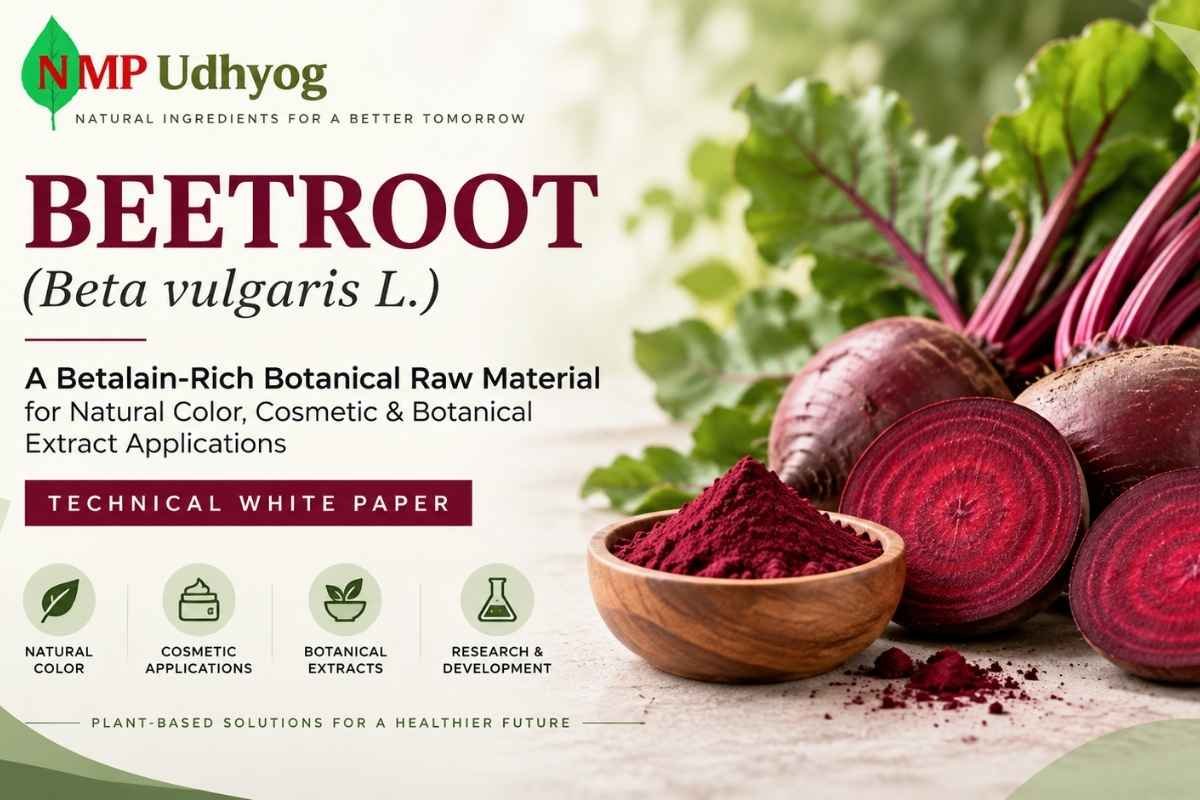
A Betalain-Rich Botanical Raw Material for Natural Color, Cosmetic & Botanical Extract Applications
Technical White Paper
Botanical Name: Beta vulgaris L.
Common Name: Beetroot / Red Beet / Beet
Family: Amaranthaceae
Plant Part: Root
Material Type: Botanical Raw Material for Extraction / Further Processing
Primary Phytochemical Interest: Betalains
Principal Pigment Classes: Betacyanins and Betaxanthins
Executive Summary
Beetroot, botanically identified as Beta vulgaris L., is a naturally pigmented botanical raw material widely recognized for its distinctive red-violet coloration.
The characteristic color of red beetroot is primarily associated with betalains, a group of water-soluble nitrogen-containing pigments. Betalains are divided into two principal groups:
- Betacyanins — red to violet pigments
- Betaxanthins — yellow to orange pigments
Among the beetroot betalains, betanin is one of the principal and most extensively studied red-violet pigments. Other characterized beetroot pigments include isobetanin, neobetanin and betaxanthin compounds such as vulgaxanthin I.
Beetroot therefore represents a valuable botanical feedstock for manufacturers developing:
- Natural color ingredients
- Botanical extracts
- Cosmetic colorants
- Personal-care ingredients
- Natural-origin formulations
- Food color ingredients, where the supplied grade and regulatory status permit
- Research and development applications involving betalain-rich extracts
Our beetroot raw material can be supplied for direct processing, extraction, concentration, standardization or further formulation.
1. Botanical Identity
| Parameter | Specification |
|---|---|
| Botanical Name | Beta vulgaris L. |
| Common Names | Beetroot, Red Beet, Beet |
| Family | Amaranthaceae |
| Plant Part | Root |
| Material Category | Botanical raw material |
| Principal Phytochemical Interest | Betalains |
| Major Pigment Groups | Betacyanins and betaxanthins |
| Intended Processing | Extraction / further processing |
2. Beetroot as a Botanical Raw Material
The beetroot root contains naturally occurring pigments and other phytochemicals.
For industrial extraction, the pigment fraction is particularly important because betalains provide the characteristic red-violet and yellow-orange coloration associated with beetroot.
Betalains are water-soluble pigments that accumulate in plant tissues and are commercially recognized for their potential as natural colorants.
The chemical composition of beetroot may vary according to:
- Botanical variety
- Cultivar
- Geographic origin
- Soil conditions
- Climate
- Maturity
- Harvest period
- Storage
- Drying conditions
- Processing method
Consequently, analytical characterization is important when beetroot is intended for standardized industrial extraction.
3. Key Phytochemical Profile
The primary phytochemical interest for red beetroot is the betalain fraction.
Major Pigment Classes
Betacyanins
Betacyanins are responsible for red-to-violet coloration.
Important beetroot betacyanins include:
- Betanin
- Isobetanin
- Neobetanin
- Related betacyanin derivatives
Betanin is one of the most important and characteristic beetroot pigments. It is the glucoside form of betanidin and is widely studied as a natural red-violet pigment.
Betaxanthins
Betaxanthins provide yellow-to-orange coloration.
A well-known beetroot betaxanthin is:
- Vulgaxanthin I
Other minor betaxanthin compounds may also occur depending on the botanical material and analytical method.
4. Why Betalains Matter
Betalains are water-soluble natural pigments with significant interest in natural-color applications.
Their color characteristics make beetroot particularly relevant to manufacturers seeking alternatives to synthetic colorants.
Primary Commercial Characteristics
- Natural red-violet coloration
- Water solubility
- Botanical origin
- Betacyanin-rich pigment fraction
- Presence of betaxanthins
- Suitability for extraction and concentration
- Potential application in natural-origin product development
Betalains have been investigated for applications in food, cosmetics and other industries, although their stability must be carefully considered during processing and formulation.
5. Raw Material → Extract → Finished Product
Our beetroot raw material can serve as a starting material for manufacturers producing standardized botanical extracts.
Typical Value Chain
Beetroot Root
↓
Controlled Extraction
↓
Betalain-Rich Extract
↓
Concentration / Standardization
↓
Natural Color / Botanical Ingredient
↓
Finished Product
The customer's extraction and standardization process can be optimized according to the required:
- Betalain concentration
- Color strength
- Shade
- Solids content
- Stability
- Application
- Regulatory requirements
6. Extraction Considerations
Betalains are sensitive to processing conditions. Published research identifies temperature, pH, light, oxygen, water activity and metal ions among the factors that can affect betalain stability.
Accordingly, extraction manufacturers may optimize:
- Raw material particle size
- Solid-to-liquid ratio
- Extraction temperature
- Extraction time
- Solvent system
- Oxygen exposure
- Filtration
- Concentration
- Drying method
- Packaging atmosphere
- Storage conditions
The objective is to maximize pigment recovery while minimizing degradation.
7. Betalain Stability
Stability is one of the most important technical considerations when working with beetroot extracts.
Research indicates that betalains are particularly affected by:
Temperature
Elevated temperatures can accelerate pigment degradation.
Light
Exposure to light can reduce betalain stability, with degradation increasing as light exposure increases.
Oxygen
Betalains can undergo oxidative degradation. Reduced oxygen exposure can improve pigment stability.
pH
Betalains generally show useful stability under mildly acidic to near-neutral conditions, while strongly alkaline conditions can cause significant degradation. A review reports particularly favorable betanin stability around pH 5–6.
Water Activity
Water activity can also influence pigment stability, particularly during storage of concentrated or dried materials.
8. Cosmetic & Personal-Care Applications
Beetroot-derived betalains have research interest for cosmetic and personal-care applications as naturally derived color ingredients.
Potential Applications
- Color cosmetics
- Lip products
- Blush formulations
- Tinted creams
- Botanical skin-care products
- Facial products
- Hair-care products
- Shampoos and conditioners requiring botanical color concepts
- Natural-origin personal-care formulations
- Botanical extracts
The actual suitability of beetroot-derived colorants depends on the intended cosmetic application, product category, jurisdiction and applicable cosmetic regulations.
9. Natural Color Applications
The strongest commercial positioning for beetroot is its role as a natural pigment source.
Beetroot betalains can provide:
Red to Violet Shades
Primarily associated with betacyanins such as betanin.
Yellow to Orange Shades
Associated with betaxanthins.
This makes beetroot particularly interesting for manufacturers developing products with a natural-origin color positioning.
10. Food & Beverage Applications
Beetroot betalains are widely studied and commercially recognized as natural colorants in food applications.
Potential applications include:
- Beverages
- Dairy products
- Yogurt
- Desserts
- Ice cream
- Sauces
- Jams and jellies
- Confectionery
- Bakery products
- Plant-based products
- Other food systems where permitted
Published reviews describe beetroot betalains as important natural pigments for food applications.
Regulatory Note: Food use must be evaluated against the regulatory status, purity specification and permitted use of the particular beetroot material or extract in the destination market.
11. Botanical Extract Applications
Beyond color, beetroot is also used as a botanical source of naturally occurring compounds.
The root contains a broader phytochemical profile that may include:
- Betalains
- Phenolic compounds
- Flavonoids
- Organic acids
- Dietary constituents
- Naturally occurring minerals
However, the concentration of these constituents varies substantially with botanical source and processing.
For commercial products, specific functional or health claims should be based on analytical and application-specific evidence.
12. Quality Parameters for Industrial Beetroot Raw Material
For customers using beetroot as an extraction feedstock, the following parameters are recommended for evaluation.
| Parameter | Importance |
|---|---|
| Botanical identification | Confirms authentic Beta vulgaris |
| Betalain content | Key pigment parameter |
| Betacyanin content | Important for red-violet color |
| Betaxanthin profile | Important for yellow-orange pigment fraction |
| Color value / absorbance | Supports pigment strength evaluation |
| Moisture | Storage and processing control |
| Foreign matter | Raw-material purity |
| Total ash | General quality indicator |
| Particle size | Extraction consistency |
| Microbiology | Quality and safety |
| Heavy metals | Regulatory/customer requirements |
| Pesticide residues | Botanical quality control |
| Aflatoxins, where applicable | Safety assessment |
| Organoleptic characteristics | Routine batch assessment |
13. Recommended Analytical Characterization
For industrial customers producing standardized beetroot extracts, analytical testing may include:
Total Betalains
Quantification of the overall betalain fraction using an appropriate validated spectrophotometric or chromatographic method.
Betacyanin / Betaxanthin Profile
Separate characterization of the principal pigment classes can provide additional information about color composition.
HPLC / HPLC-DAD
HPLC can be used for characterization and quantification of individual betalains.
Reported beetroot studies have identified major pigments including betanin, isobetanin, neobetanin and vulgaxanthin I using chromatographic and mass-spectrometric approaches.
Color Strength
For commercial color ingredients, absorbance-based measurements can provide a useful indicator of pigment concentration and batch consistency.
The analytical method should always be specified alongside the reported numerical value.
14. Formulation Considerations
When developing products using beetroot-derived pigments, formulators should consider:
- Final pH
- Temperature exposure
- Light exposure
- Oxygen exposure
- Water activity
- Metal ions
- Packaging
- Storage conditions
- Processing time
- Other formulation ingredients
Because betalains can be sensitive to environmental conditions, formulation and stability testing should be conducted using the specific commercial extract or raw material.
15. Potential Industrial Applications
Cosmetics & Personal Care
- Color cosmetics
- Botanical skin-care products
- Tinted formulations
- Hair-care products
- Natural-origin personal care
Food & Beverage
- Natural food colorants
- Beverages
- Dairy systems
- Desserts
- Sauces
- Confectionery
- Bakery applications
Botanical Extract Manufacturing
- Betalain-rich extracts
- Standardized beetroot extracts
- Botanical pigment concentrates
Research & Development
- Natural pigment systems
- Plant-derived colorants
- Stabilized pigment systems
- Encapsulated botanical color ingredients
16. Application Matrix
| End Use | Raw Beetroot | Beetroot Extract | Standardized Pigment Extract |
|---|---|---|---|
| Natural color development | ✓ | ✓ | ✓ |
| Cosmetic applications | ✓ | ✓ | ✓ |
| Color cosmetics | — | ✓ | ✓ |
| Skin-care formulations | ✓ | ✓ | ✓ |
| Hair-care formulations | ✓ | ✓ | ✓ |
| Food & beverage* | ✓ | ✓ | ✓ |
| Botanical extracts | ✓ | ✓ | ✓ |
| Natural pigment manufacturing | ✓ | ✓ | ✓ |
| Research & development | ✓ | ✓ | ✓ |
*Subject to applicable food regulations and the specification/grade of the supplied material.
17. Three Commercial Use Routes
Our beetroot raw material can support three principal customer pathways.
A. Direct Botanical Use
Customers may incorporate appropriately processed beetroot material into products where the raw botanical form is suitable.
B. Extraction
Customers may extract the betalain-rich fraction and manufacture their own beetroot extract.
C. Concentration & Standardization
Customers may further concentrate and standardize the extract according to a defined pigment or color-strength specification.
This allows manufacturers to develop beetroot ingredients tailored to their own application requirements.
18. What Makes a Good Beetroot Extraction Feedstock?
For industrial extraction, high-quality beetroot raw material should demonstrate:
1. Authentic Botanical Identity
Correct identification as Beta vulgaris.
2. Strong Natural Pigment Content
A suitable betalain concentration for the intended extraction process.
3. Consistent Color Characteristics
Helps support reproducible extract production.
4. Controlled Moisture
Supports storage and predictable processing.
5. Low Foreign Matter
Improves raw-material purity.
6. Good Microbiological Quality
Supports controlled manufacturing.
7. Controlled Contaminants
Heavy metals and pesticide residues should comply with agreed customer and market requirements.
8. Consistent Supply
Reliable botanical sourcing and batch traceability are important for commercial extract production.
19. Customer Evaluation Protocol
Before commercial scale-up, customers are encouraged to conduct laboratory extraction trials using representative samples.
A suitable evaluation may include:
Beetroot Raw Material
↓
Betalain Analysis
↓
Laboratory Extraction
↓
Extraction Yield
↓
Betalain Recovery
↓
Color Strength
↓
Stability Testing
↓
Final Application Testing
This approach allows customers to establish the appropriate extraction conditions for their manufacturing process.
20. Stability & Packaging Considerations
Because betalains can be sensitive to light, oxygen and temperature, appropriate packaging and storage conditions are important.
Recommended controls may include:
- Protection from direct light
- Controlled temperature
- Moisture protection
- Oxygen minimization where appropriate
- Suitable barrier packaging
- Controlled storage humidity
Specific shelf life should be established from stability testing of the actual commercial grade and packaging system.
21. Quality & Traceability
Recommended batch documentation may include:
- Botanical identity
- Country/region of origin
- Harvest information, where available
- Batch number
- Processing date
- Moisture
- Betalain/color specification
- Microbiological analysis
- Heavy-metal analysis
- Pesticide analysis, where applicable
- Storage conditions
- Certificate of Analysis
Traceability provides customers with greater confidence in raw-material consistency and supports downstream quality management.
22. Technical Positioning
The commercial value of beetroot as a raw material should be evaluated primarily through its:
- Botanical authenticity
- Natural betalain content
- Color strength
- Extraction recovery
- Batch consistency
- Stability
- Traceability
Rather than relying solely on the visual intensity of the raw beetroot, industrial buyers should evaluate the measurable pigment content and extraction performance.
23. Important Technical Note
Published research demonstrates substantial variation in beetroot betalain composition and stability depending on botanical material, processing conditions and analytical methodology.
Therefore, literature values should be treated as technical reference information, not as guaranteed specifications for a commercial batch.
Commercial specifications should be based on batch-specific analytical testing and an agreed analytical method.
Likewise, color strength, stability, cosmetic performance and other application claims should be established through appropriate testing using the specific commercial material.
24. Conclusion
Beetroot (Beta vulgaris L.) is a valuable botanical raw material for manufacturers seeking naturally derived pigment and botanical extract solutions.
Its most commercially significant pigment constituents are betalains, comprising:
Betacyanins → red/violet coloration
and
Betaxanthins → yellow/orange coloration
with betanin being a major characteristic beetroot betacyanin.
The material can serve as a starting point for:
- Natural color ingredients
- Cosmetic color applications
- Personal-care formulations
- Food and beverage color applications, where permitted
- Botanical extracts
- Betalain-rich concentrates
- Natural-origin product development
For industrial customers, the key evaluation criteria are pigment content, extraction recovery, color strength, stability, purity, consistency and traceability.
Our beetroot raw material is supplied as a botanical feedstock for customers who wish to develop their own extraction, concentration and standardization processes.
Technical Information Summary
| Attribute | Information |
|---|---|
| Botanical name | Beta vulgaris L. |
| Common name | Beetroot / Red Beet |
| Family | Amaranthaceae |
| Plant part | Root |
| Main phytochemical interest | Betalains |
| Main pigment groups | Betacyanins & Betaxanthins |
| Important pigment | Betanin |
| Primary color range | Red / violet / yellow-orange |
| Intended use | Extraction / further processing |
| Main industries | Cosmetics, personal care, food & beverage, botanical extracts |
| Key quality parameter | Betalain / color strength |
| Key technical consideration | Pigment stability |
| Standardization | Customer-specific |
| Quality testing | According to agreed specification |
| Traceability | Batch-based |
Disclaimer
This document is provided for technical and informational purposes to support ingredient evaluation and product development.
The information does not constitute a guarantee of finished-product performance, safety or regulatory approval.
The suitability of beetroot raw material or extracts for a particular cosmetic, food, personal-care or other application must be independently evaluated by the customer.
Food, cosmetic and other regulatory requirements vary by jurisdiction and product category. Customers are responsible for confirming the regulatory status and permitted use of the specific material or extract in their intended market.
Commercial specifications should be confirmed through the applicable Certificate of Analysis and Technical Data Sheet for the supplied batch.