
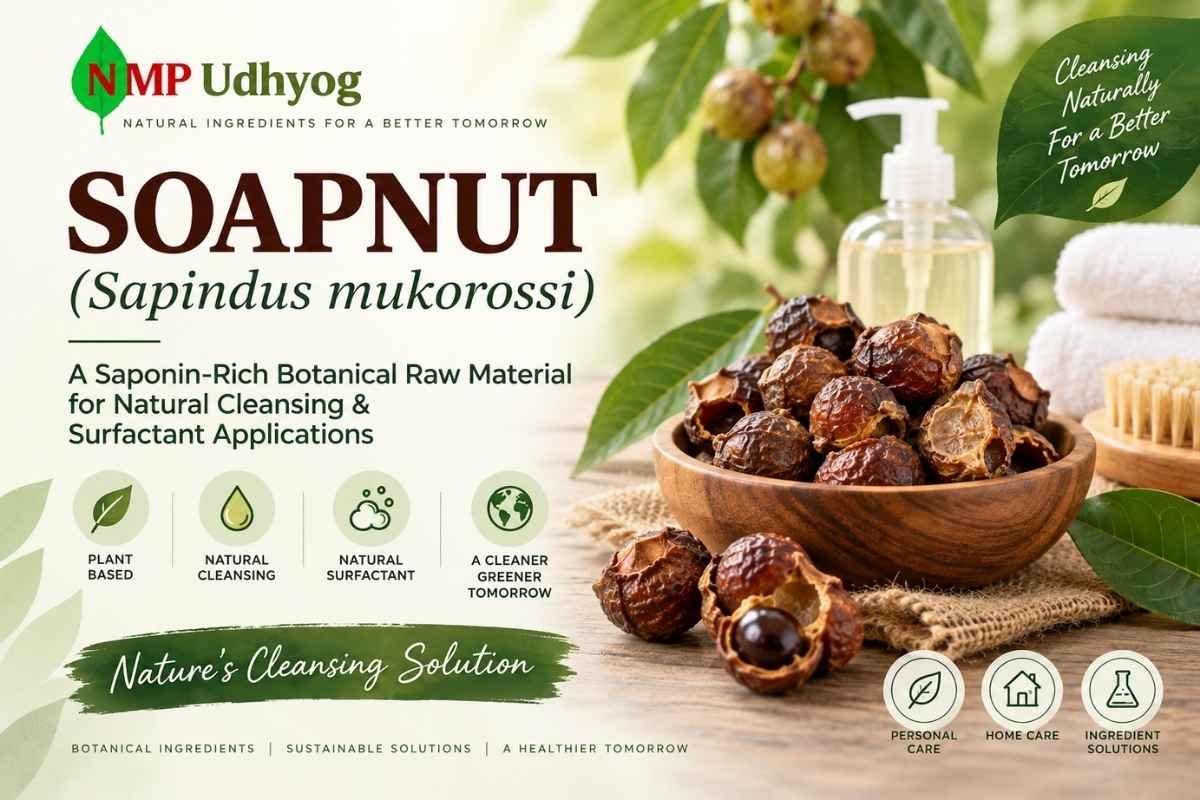
A Saponin-Rich Botanical Raw Material for Natural Cleansing & Surfactant Applications
Technical White Paper
Botanical Source: Sapindus mukorossi Gaertn.
Family: Sapindaceae
Plant Part: Fruit Pericarp / Fruit Shell
Material Type: Botanical Raw Material for Extraction
Primary Phytochemical Class: Triterpenoid Saponins
Executive Summary
Soapnut, botanically identified as Sapindus mukorossi Gaertn., is a naturally saponin-rich botanical material traditionally used for cleansing and washing applications.
The fruit pericarp contains naturally occurring triterpenoid saponins, which are responsible for the characteristic foaming, cleansing and surface-active properties associated with Soapnut.
Because of this natural saponin content, Sapindus mukorossi fruit pericarp can serve as a valuable raw material for the manufacture of botanical saponin extracts used in personal care, natural cosmetics, home care and eco-friendly cleaning formulations.
Our Soapnut raw material is supplied primarily as an extraction feedstock, enabling customers to process the botanical material according to their own extraction, concentration and standardization requirements.
The objective is to provide customers with a consistent, traceable and saponin-rich botanical starting material suitable for further processing.
1. Botanical Identity
| Parameter | Specification |
|---|---|
| Botanical Name | Sapindus mukorossi Gaertn. |
| Common Names | Soapnut, Soapberry, Reetha, Aritha |
| Family | Sapindaceae |
| Plant Part | Fruit / Pericarp |
| Material Category | Botanical raw material |
| Primary Constituent Class | Triterpenoid saponins |
| Intended Processing | Extraction / further processing |
Sapindus mukorossi is a deciduous tree belonging to the Sapindaceae family. Its fruits contain a saponin-rich pericarp that has historically been used as a natural cleansing material.
2. The Soapnut Fruit Pericarp
The pericarp, commonly referred to as the fruit shell, is the principal part of the Soapnut fruit associated with its cleansing activity.
The pericarp contains naturally occurring triterpenoid saponins. These compounds possess both hydrophilic and hydrophobic structural characteristics, allowing them to interact with aqueous and oily phases.
This amphiphilic nature is responsible for the characteristic surface-active behavior of Soapnut-derived saponins.
For industrial extraction, the fruit pericarp therefore represents the key botanical fraction of interest.
3. Key Phytochemical Constituents
The major chemical interest in Sapindus mukorossi fruit is its triterpenoid saponin fraction.
Reported saponin constituents include compounds belonging to several triterpenoid structural classes.
Principal Phytochemical Groups
- Triterpenoid saponins
- Sapindosides
- Mukurozi-saponins
- Oleanane-type triterpenoid saponins
- Other structurally related triterpenoid saponins
Reported compounds include various sapindosides and mukurozi-saponins.
The exact phytochemical profile may vary according to:
- Botanical source
- Geographic origin
- Cultivar or population
- Fruit maturity
- Harvest period
- Drying conditions
- Storage conditions
- Particle size
- Extraction method
- Extraction solvent
- Solid-to-liquid ratio
- Processing temperature
Consequently, analytical characterization of each commercial batch is important for industrial applications.
4. Why Saponins Matter
Saponins are naturally occurring surface-active plant compounds.
Their molecular structure contains a relatively hydrophobic aglycone portion together with hydrophilic sugar components.
This structure allows saponins to interact with water and hydrophobic substances.
As a result, Soapnut-derived saponins have potential utility in applications requiring:
Natural Cleansing
Soapnut-derived saponins can contribute to the removal and dispersion of oils and other hydrophobic materials.
Foaming
Saponins can generate foam when dispersed in aqueous systems. Foam characteristics depend on concentration, extraction method, formulation composition, water quality and processing conditions.
Natural Surfactant Systems
Soapnut provides a botanical source of surface-active compounds for manufacturers developing plant-derived cleansing systems.
5. Raw Material → Extract → Finished Formulation
Our Soapnut is intended primarily as a botanical extraction raw material.
Typical Value Chain
Soapnut Fruit / Pericarp
↓
Controlled Extraction
↓
Saponin-Rich Botanical Extract
↓
Standardization / Concentration
↓
Finished Cosmetic, Personal Care or Cleaning Formulation
This approach allows extract manufacturers to select their preferred extraction technology and standardization target.
6. Extraction Considerations
The saponin fraction can be recovered using appropriate extraction processes.
Depending on the intended application, manufacturers may employ aqueous or hydro-alcoholic extraction and subsequent filtration, concentration and drying operations.
Typical process variables include:
- Raw material particle size
- Water-to-material ratio
- Extraction temperature
- Extraction time
- Number of extraction cycles
- Filtration efficiency
- Concentration method
- Drying method
- Final standardization
The extraction process should be optimized according to the desired:
- Saponin concentration
- Extraction recovery
- Color
- Odor
- Solids content
- Microbiological quality
- Formulation compatibility
7. Importance of Raw Material Saponin Content
For industrial extraction customers, total saponin content is one of the most important indicators of raw-material value.
A higher and more consistent saponin content can provide a stronger starting point for producing standardized botanical extracts.
However, extraction recovery is not determined solely by the starting saponin percentage.
Actual recovery depends on the complete extraction process.
Therefore, customers should evaluate both:
Raw Material Saponin Content
and
Saponin Recovery During Extraction
when comparing suppliers.
8. Suggested Quality-Control Parameters
The following parameters are recommended for industrial evaluation of Soapnut raw material.
| Quality Parameter | Purpose |
|---|---|
| Botanical identification | Confirms authentic S. mukorossi |
| Total saponins | Measures key phytochemical fraction |
| Saponin fingerprint | Supports authenticity and batch consistency |
| Moisture | Storage and processing control |
| Foreign matter | Raw material purity |
| Total ash | General quality indicator |
| Particle size | Extraction process consistency |
| Microbiological analysis | Quality and safety |
| Heavy metals | Regulatory/customer requirements |
| Pesticide residues | Natural botanical supply-chain control |
| Aflatoxins, where applicable | Botanical safety assessment |
| Bulk density | Handling and process planning |
| Organoleptic characteristics | Routine batch evaluation |
Final acceptance limits should be established according to the customer's application, regulatory market and agreed product specification.
9. Recommended Analytical Characterization
For customers requiring standardized extracts, analytical characterization may include:
Total Saponins
Quantification of the overall saponin fraction using a validated analytical method.
HPLC / HPLC-MS
Chromatographic profiling can be used to characterize the saponin fraction and support botanical authenticity and batch-to-batch consistency.
Phytochemical Fingerprinting
A characteristic chromatographic fingerprint can provide additional information regarding the chemical composition of the raw material.
Because different analytical methods can produce different numerical results, the analytical method should always be specified together with the reported saponin value.
10. Potential Industrial Applications
Personal Care
- Shampoo
- Hair cleansers
- Scalp cleansing products
- Body wash
- Facial cleansers
- Botanical cleansing products
Natural Cosmetics
- Natural-origin cleansing systems
- Botanical formulations
- Plant-derived surfactant systems
Home & Institutional Care
- Natural cleaning products
- Eco-friendly detergents
- Botanical cleaning concentrates
Ingredient Manufacturing
- Standardized Soapnut extract
- Saponin-rich botanical extracts
- Natural surfactant ingredients
The final application should be evaluated through appropriate formulation and performance testing.
11. Formulation Development
Soapnut-derived saponin extracts can be incorporated into aqueous cleansing systems.
The optimum dosage depends on:
- Extract concentration
- Total saponin content
- Extraction method
- Final formulation
- Desired foam profile
- Cleansing performance
- Other surfactants present
- Water hardness
- pH
- Electrolyte concentration
For this reason, a universal formulation dosage should not be assumed.
Customers should determine the optimum use level through formulation trials using the specific grade supplied.
12. Concentration & Standardization
An important distinction should be made between:
Raw Soapnut Material
The natural fruit/pericarp used as an extraction feedstock.
Liquid Soapnut Extract
A concentrated botanical liquid containing soluble constituents extracted from the raw material.
Standardized Soapnut Extract
An extract adjusted or concentrated to meet a defined specification, such as a target saponin content.
Concentrated Extract Powder
A dried extract with substantially higher solids and, where applicable, a defined saponin standardization.
These materials should not be compared solely on weight percentage because extraction ratio, solids content and analytical methodology can differ.
13. Sustainability Considerations
Soapnut offers an attractive botanical source for manufacturers developing plant-derived cleansing ingredients.
Use of Soapnut-derived ingredients can support product-development strategies focused on:
- Plant-derived raw materials
- Renewable botanical resources
- Natural-origin formulations
- Biobased cleansing systems
- Alternative surfactant concepts
Sustainability claims should be supported by the supplier's actual sourcing, processing and supply-chain documentation.
14. Traceability
For industrial customers, raw-material traceability is an important component of quality assurance.
Recommended traceability information includes:
- Botanical identity
- Country/region of origin
- Harvest period
- Supplier/producer identification
- Batch number
- Processing date
- Storage conditions
- Certificate of Analysis
- Relevant analytical reports
Batch-specific documentation can be provided according to the agreed commercial specification.
15. Storage & Handling
Soapnut raw material should be stored in clean, dry and suitable packaging under conditions that minimize:
- Moisture absorption
- Excessive heat
- Direct sunlight
- Pest contamination
- Cross-contamination
Recommended storage conditions and shelf life should be established according to the actual commercial product specification and packaging configuration.
16. Quality Philosophy
Our objective is to supply Soapnut raw material that provides manufacturers with a consistent and reliable botanical starting material for extraction and further processing.
Quality control focuses on:
- Botanical authenticity
- Raw-material purity
- Saponin content
- Batch consistency
- Traceability
- Microbiological and contaminant control
This approach enables customers to develop their own standardized Soapnut extracts and finished formulations with greater control over the final product specification.
17. What Makes a Good Soapnut Extraction Feedstock?
For industrial extraction, the value of Soapnut raw material should be assessed across multiple parameters rather than appearance alone.
A high-quality feedstock should demonstrate:
1. Authentic Botanical Identity
Correct identification as Sapindus mukorossi.
2. High and Consistent Saponin Content
Provides a strong chemical basis for extraction.
3. Low Foreign Matter
Improves raw-material purity.
4. Controlled Moisture
Supports storage stability and predictable processing.
5. Good Microbiological Quality
Reduces processing and formulation risks.
6. Controlled Contaminants
Heavy metals and pesticide residues should meet agreed customer and market requirements.
7. Consistent Particle Characteristics
Supports reproducible extraction.
8. Reliable Supply
Consistent sourcing and batch traceability are essential for industrial production.
18. Recommended Customer Evaluation
Before commercial scale-up, customers are encouraged to conduct their own extraction trials using representative samples.
A suitable evaluation may include:
Raw Material
↓
Total Saponin Analysis
↓
Laboratory Extraction
↓
Extraction Yield
↓
Saponin Recovery
↓
Concentration
↓
Final Extract Characterization
↓
Formulation Performance
This allows customers to determine the most appropriate extraction conditions for their own manufacturing process.
19. Important Technical Note
Published scientific literature provides different values for the saponin content of Sapindus mukorossi depending on the plant material, extraction procedure and analytical methodology.
Therefore, literature values should be treated as reference information rather than a guaranteed specification for a commercial batch.
The commercial specification should always be based on batch-specific analytical testing and an agreed analytical method.
Likewise, cleansing, foaming, surface-tension and formulation-performance claims should be supported by appropriate laboratory testing using the specific commercial grade.
20. Conclusion
Sapindus mukorossi fruit pericarp represents a valuable botanical source of naturally occurring triterpenoid saponins.
Its naturally surface-active constituents make Soapnut an attractive raw material for manufacturers developing:
- Natural cleansing ingredients
- Botanical extracts
- Plant-derived surfactant systems
- Personal-care formulations
- Hair-care products
- Eco-friendly cleaning products
For extract manufacturers, the most important considerations are botanical authenticity, saponin content, extraction recovery, consistency, purity and traceability.
Our Soapnut raw material is supplied as an industrial botanical feedstock, allowing customers to apply their own extraction and standardization processes to manufacture saponin-rich ingredients tailored to their applications.
Technical Information Summary
| Attribute | Information |
|---|---|
| Botanical Name | Sapindus mukorossi Gaertn. |
| Common Name | Soapnut / Soapberry / Reetha / Aritha |
| Family | Sapindaceae |
| Plant Part | Fruit Pericarp |
| Main Phytochemical Class | Triterpenoid saponins |
| Key Chemical Interest | Saponin-rich fraction |
| Intended Use | Extraction / further processing |
| Application Areas | Personal care, cosmetics, home care, natural cleaning |
| Extraction | Customer-specific |
| Standardization | Customer-specific |
| Quality Testing | According to agreed specification |
| Traceability | Batch-based |
Disclaimer
This document is provided for technical and informational purposes to support ingredient evaluation and product development.
The information does not constitute a guarantee of finished-product performance. Final formulation performance, safety, regulatory compliance and suitability for a particular application must be independently evaluated by the customer.
Specifications, analytical methods, claims and regulatory requirements may vary according to product grade, intended application and destination market.
All commercial specifications should be confirmed through the applicable Certificate of Analysis and Technical Data Sheet for the supplied batch.
End-Use Applications
Sapindus mukorossi fruit pericarp can be supplied as a botanical raw material for direct-use applications as well as extraction and further processing. Its naturally occurring triterpenoid saponins make it relevant to a range of cleansing and natural-origin product concepts.
1. Cosmetic & Personal Care Applications
Soapnut fruit/pericarp can be used as a botanical raw material in the development of natural and plant-derived personal-care products.
Potential Applications
- Shampoo and hair cleansers
- Scalp-cleansing formulations
- Hair-care products
- Body wash and shower products
- Facial cleansing products
- Hand cleansers
- Botanical cleansing formulations
- Natural-origin personal-care products
Customers may use the raw material directly where appropriate, or extract and concentrate the saponin fraction for incorporation into cosmetic formulations.
2. Laundry & Home-Care Applications
Soapnut is traditionally associated with natural washing and cleansing because of its naturally occurring saponins.
The fruit pericarp can therefore be evaluated as a botanical raw material for:
- Laundry detergents
- Liquid laundry cleaners
- Natural washing formulations
- Fabric-cleaning products
- Household cleaning products
- Multi-purpose cleaners
- Eco-friendly cleaning formulations
- Plant-derived cleaning concentrates
For industrial applications, the raw material may be processed into a liquid or concentrated saponin-rich extract before incorporation into the final cleaning formulation.
3. Raw Material for Saponin Extraction
A key industrial application of Sapindus mukorossi fruit pericarp is its use as a raw material for manufacturing botanical extracts.
Typical Process
Soapnut Fruit / Pericarp
↓
Extraction
↓
Saponin-Rich Extract
↓
Concentration / Standardization
↓
Cosmetic / Personal Care / Home-Care Ingredient
This route is particularly relevant for:
- Botanical extract manufacturers
- Natural surfactant manufacturers
- Cosmetic ingredient suppliers
- Personal-care ingredient manufacturers
- Natural detergent manufacturers
- Contract extract manufacturers
Customers can optimize the extraction process according to their required saponin concentration, recovery, color, solids content and final application.
Application Matrix
| End Use | Raw Soapnut | Soapnut Extract | Saponin Concentrate |
|---|---|---|---|
| Shampoo | ✓ | ✓ | ✓ |
| Hair cleanser | ✓ | ✓ | ✓ |
| Scalp care | ✓ | ✓ | ✓ |
| Facial cleanser | ✓ | ✓ | ✓ |
| Body wash | ✓ | ✓ | ✓ |
| Natural cosmetics | ✓ | ✓ | ✓ |
| Laundry products | ✓ | ✓ | ✓ |
| Natural detergents | ✓ | ✓ | ✓ |
| Household cleaners | ✓ | ✓ | ✓ |
| Botanical ingredient manufacturing | ✓ | ✓ | ✓ |
| Natural surfactant manufacturing | — | ✓ | ✓ |
Note: Suitability and dosage depend on the form of the material, extraction process, final formulation and applicable regulatory requirements. Customers should conduct formulation and performance testing before commercial use.
Three Commercial Use Routes
Our Soapnut raw material can therefore serve three different customer needs:
A. Direct Botanical Use
Customers incorporate the Soapnut fruit/pericarp or appropriately processed material directly into natural cleaning concepts.
B. Extraction
Customers extract the naturally occurring saponin fraction and manufacture their own Soapnut extract.
C. Further Concentration & Standardization
Customers process the extract into a standardized, concentrated saponin ingredient for use in cosmetic, personal-care and cleaning formulations.
This flexibility makes Sapindus mukorossi a versatile botanical raw material for manufacturers developing natural cleansing, personal-care and eco-friendly cleaning products.